Showing posts with label Timelines. Show all posts

Monday, March 23, 2015

A brief history of Civil Rights, Atlanta's relevance in the movement and Tom Houck

Five years ago I was introduced to a boisterous Grant Park neighbor named Tom Houck. My [then fiancĂ©] and I began to run into him often, usually at our next door neighbor's house or our favorite local pub, Augustine's. When Tom asked what we wanted as a wedding gift I thought for a moment and said "a personal tour of the Civil Rights Movement in Atlanta from you". 

For those of you who don't already know this conspicuous Atlantan: Tom was the driver for the King family from 1966 until Martin's assassination in 1968. From there he joined the staff of the Southern Christian Leadership conference. In the early '70s Tom worked with John Lewis and Julian Bond on a project encouraging minorities to vote. His involvement with politics, combined with a long standing interest in journalism, grew into a career in radio and TV. Since 1980 Houck has been an outspoken, liberal, staple of the Atlanta media. This month he launches his own Civil Rights bus tour. The tagline: "taking you to to the places where history was made by those who made history".

I am someone who is passionate about history, Atlanta and sharing interesting stories. So when Tom told me he was finally starting this company I insisted on being involved. Lucky for me, Tom didn't refuse. 

The first time I ran through the route with Tom, Ron and AB I was left speechless. They took me to beautiful but decaying parts of Atlanta that I'd never seen yet were only a few miles from my home. These are places that changed the course of American history. The more they showed me and the more they talked, the more I realized I had some research to do before I was going to fully understand Atlanta's role in the American Civil Rights Movement. With that in mind I've compiled a new timeline. Hopefully it will help others to organize their thoughts and understanding about a few of Atlanta's quickly decaying but incredibly historic neighborhoods. 

A timeline of America/Atlanta leading up to the Civil Rights Movement:
• 1861 - 1865 Civil War 
• 1868 - 14th Amendment makes African Americans full citizens of the United States and prohibits states from denying them equal protection or due process of law. 
• 1870 - 15th Amendment guarantees the right to vote will not be denied or abridged on account of race. Simultaneously, Tennessee passes a law that clearly aims to defy the new amendment. This segregation law also known as "Jim Crow" mandates the separation of African Americans from whites on trains, in depots and wharves. It becomes a catalyst for the rest of the South to quickly do the same. 
• 1893 Atlanta's Wheat Street is renamed Auburn Ave to sound more cosmopolitan. 
• 1896 Ruling of Plessy v Ferguson. In 1892, Plessy bought a first-class ticket from New Orleans on the East Louisiana Railway. The Supreme Court ruled that "separate but equal" facilities were constitutional. The finding contributes to 58 more years of segregation in the south.
• By 1900 African Americans are banned from white hotels, barber shops, restaurants, theaters, schools and other public accommodations. 
• 1905 Alonzo Herndon, son of a slave owner and slave, who rose through Atlanta's African American community with his prestigious upperclass, white-only, Crystal Palace Barber Shop, founds Atlanta Life Insurance Company.
• 1906 Race Riot in Atlanta.  25 black Atlantans killed, 70 injured. Including George "Union" Wilder, a former union soldier who had become post master for South Atlanta. "Union" was shot by police officers while defending his home with a muzzle loading rifle. This riot marks the beginning of black businesses and families consciously moving to the Fourth Ward for safety via consolidation. White families begin to move out.
• By 1910 Ten of the eleven former Confederate states have passed new constitutions or amendments that deprive most blacks the right to vote. Those who can't vote are not allowed to serve on a jury and are often taken advantage of.
• 1912 Odd Fellows Building is constructed on Auburn Ave. It is first large-scale, black-owned, black-operated, multiple use complex in Atlanta (includes an auditorium). 
• 1913 Atlanta Baptist College becomes Morehouse.
• 1920 Atlanta Life Insurance building is constructed on Auburn Ave. 
• 1924 Booker T Washington High School opens as the first African American high school in Georgia. 
• 1928 Atlanta Daily World is founded. The newspaper devotes itself to coverage of black educational institutions, businesses, prominent persons, churches and other news of 
significance.
• 1929 Atlanta University Center is founded.
• 1936 John Wesley Dobbs, Maynard Jackson's grandfather, starts a voter registration drive. In 10 years he registers 20,000 minority Atlanta voters.
• 1936 Techwood Homes opens as the nation's first federal public housing project. 
• 1941 President Roosevelt issues executive order banning discrimination against minorities in defense contracts. Herndon Homes public housing is built in Vine City. 
• 1947 Jackie Robinson becomes first African American to play major league baseball. 
• 1948 President Harry S. Truman desegregates the armed services. Atlanta's police force integrates but the 8 officers are still required to use the locker rooms at the Butler Street YMCA. 
• 1954 Brown v the Board of Education declares segregated schools unconstitutional. This overturns the 1896 "separate but equal" ruling of Plessy v Ferguson.
• 1955 Montgomery Bus Boycott.
• 1956 Fortune magazine hails Auburn Ave "richest Negro street in the world". 
• 1960 Lunch counter sit-in by four college students in Greensboro, N.C. begins and spreads through the South. The Student Non-Violent Coordinating Committee (SNCC) is founded. John F. Kennedy is elected president. 
• 1961 Atlanta schools integrate on the same day Dobbs dies of a stroke.
• 1963 (August): March on Washington. MLK Jr delivers his "I have a dream" speech. 
• 1963 (September): Birmingham church is bombed killing four African American girls attending Sunday school.
• 1963 (November): JFK Jr is assassinated 
• 1964 (July): Civil Rights Act outlaws discrimination based on race, color, religion, sex, or national origin. 
• 1964 (October) MLK Jr is awarded Nobel Peace Prize.
• 1965 Selma to Montgomery march
• 1968 MLK Jr is assassinated in Memphis.
• 1979 Maynard Jackson, Dobbs’ grandson, becomes mayor of Atlanta.

BOOK YOUR TOUR TODAY! CLICK HERE.
Wednesday, July 23, 2014

The Burning of Atlanta

Yesterday marks the 150th anniversary of the Civil War campaign/battle that resulted in Sherman's burning of antebellum Atlanta. It seems fitting that this is also the week I finally receive an answer to the question I asked in November: "Hey Atlanta, what's next? Moving the Peachtree Road Race to Gwinett County?" Sadly, the answer is another direct hit to Atlanta's wonderful Grant Park neighborhood: the Cyclorama, a historic painting that depicts the Battle of Atlanta, is being moved from it's home in the park of Grant Park to the posh northern neighborhood of Buckhead. 

The Cyclorama isn't JUST a painting. Created in 1885, it is still the world’s largest oil painting (42 feet x 358 feet). Since 1893 it has been on display less than a mile from the subject matter it depicts. In 1921 it moved to it's current location: a beautiful building on the National Register of Historic Places (right next to the Zoo Atlanta entrance). It's new home will be 15 miles north of the actual battlelines (just 5 miles from the future Cobb County Braves Stadium).

The location of my home (built 56 years after the battle) can be seen in the painting - I love that. The news of the move brought tears to my eyes in the middle of a work day. After losing the Braves Stadium and the fight against a Grant Park Walmart (on my beloved Beltline no less), this annoucement feels like the nail in "historic" Grant Park's coffin. I never let the crime get to me - but these repeated betrayals by the city - they feel so personal. They sting.

Details about the Atlanta Campaign:
• July 22, 1864: Sherman orders that any artillery positioned within range begin cannonading, not just of the Confederate lines but also of the city itself, which still held about 3,000 civilians (down from 20,000 earlier in the spring). Battle lines correspond with present day Moreland Avenue (south from the Edgewood Shopping center to I-20) and then turn 90 degrees West (towards the city) and follow along 1-20.
• August 9, 1864: The barrage of Union artillery peaks with approximately 5,000 shells fired into Atlanta.
• September 2, 1864: Union Soldiers finally penetrate the city. Atlanta falls to General Sherman.
• Sherman occupies Atlanta for 10 weeks.
• Early November 1864: Sherman orders his engineers to begin "the destruction in Atlanta of all depots, car-houses, shops, factories, foundries."
• November 12, 1864: Orders are given to begin torching designated sites, some with explosive shells placed inside. Locations include a storehouse at Whitehall and Forsyth streets, a bank at the railroad and Peachtree Street and the Washington hotel.
• November 15, 1864: Leaving along Decatur Road (which in turns is also Marietta Boulevard and DeKalb Avenue) Union troops leave a smoldering Atlanta and begin their march to the coast.
• December 2, 1864: Sherman and his troops arrive in Savannah. The city surrenders.

Thursday, November 14, 2013

A short history of baseball and mass transit in Atlanta

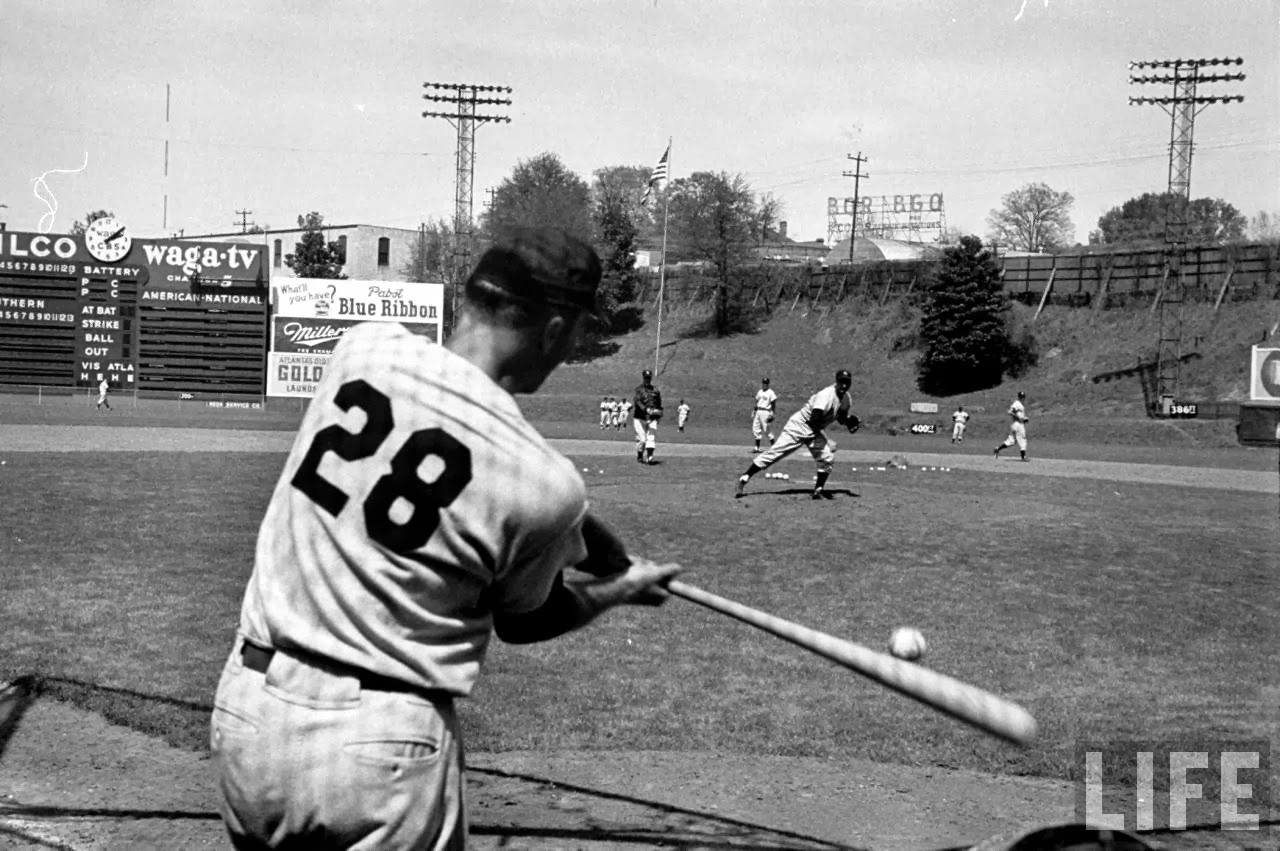
The recent announcement that Atlanta's Braves plan to leave the city center in favor of a new suburban stadium has caught the entire nation by surprise. While I am not in favor of the move, the decision reminds me of the various roles transit has played in Atlanta baseball. In my mind, the two have always been intertwined: Atlanta's earliest organized baseball team, the Cracker's, played in a stadium accessible by streetcar. Ivan Allen chose the location for Atlanta Fulton County's Stadium based on it's proximity to "the Georgia State Capitol, downtown businesses and major highways". (Turner Field was built beside the original Braves stadium - but I don't know enough about the Olympic plans to say if consideration had been given to building elsewhere.) 

With all of that in mind, a brief (unofficial) history of baseball and mass transit in Atlanta:


• 1866 - Georgia’s General Assembly charters the Atlanta Street Railway Company.
• September 8, 1871 - The first horse drawn trolley line begins operation. Tracks extend from the city’s center to Peters Street near the present location of Spellman College. The “West End” line goes along Mitchell and Forsyth to the Fort McPherson Barracks.

• January 1872 - Service added from Marietta Street (downtown) running northwest to North Avenue
• May 1872 - Service added from Decatur Street (downtown) running east to the north entrance of Oakland Cemetery (no longer an entrance)
• August 1872 - Service added from downtown running north along Peachtree Street to Pine Street.
• 1874 - Peachtree line is extended further north to the present intersection of Peachtree Street and Ponce de Leon Ave. "Since the Ponce de Leon Avenue did not exist at the time, the rail line traveled east on a private right-of-way to Ponce de Leon Springs, a popular seasonal recreation spot in the lands beyond the city" [1].
• February 11, 1885 - the south's first organized, professional baseball league is formed by Henry W. Grady. At the end of the 100 game season Atlanta narrowly defeats Augusta to win the first Southern League pennant [2].
• 1899 - Southern League officially disbands but is credited with making baseball popular in the south.
• 1901 - Southern Association is formed. Atlanta's team is the "Firemen"[3].
• 1903 - Atlanta's baseball team changes it's name to the "Crackers". The Crackers become one of professional baseball's most successful franchises, winning more titles than any other team except the Yankees [4]. They play at various parks around Atlanta. 
• May 23, 1907 - Ponce de Leon Ball Park opens; the Crackers finally have a home field. The wooden stadium is built in the amusement park at the end of the streetcar line. 
•  September 9, 1923 - The stadium burns down. Uniforms, trophies and records are lost. 
• 1924 - A new steel and concrete stadium is built by RJ Spiller, a wealthy concessionaire. "The new park debuted in time for the 1924 season, and was widely hailed as the finest minor league stadium in the nation." [5] The outfield is noted for having a pair of magnolia trees in center field; as of 2013 these trees are still standing along the access road behind Whole Foods. 
• 1940's - the proposal to build an interstate cutting through downtown Atlanta begins
• 1954 - Atlanta Cracker, Montag hits the longest home run in baseball history. "It landed in a coal car passing on the railroad tracks beyond the right field fence at the Ponce de Leon park. A few days later, after the train had gone to Nashville, Tennessee, and back, the conductor asked Montag to autograph the ball, which by that time had traveled more than 500 miles." [6]
• 1958 - Interstate development maps outline a path alongside current-day Turner Field.
• 1961 - As part of his campaign for mayor, Ivan Allen Jr promises to build a sports facility that will attract a Major League Baseball team. After winning office, Allen chose a 47-acre plot in the Washington-Rawson neighborhood for the building site, citing its proximity to the Georgia State Capitol, downtown businesses and major highways [7].
• April 15, 1964 - Groundbreaking ceremony for the future Atlanta Fulton County Stadium
• 1965 - MARTA is formed by the Georgia Legislature
• 1965 - Atlanta Crackers play their final season in the new Atlanta Fulton County Stadium.
• April 9, 1965 Milwaukee Braves play an exhibition game against the Detroit Tigers in the new stadium.
• 1966 - Both the Atlanta Falcons football team and the newly minted Atlanta Braves baseball team move into Fulton County Stadium. Both teams share this facility for the next 26 years. (In 1992 the Falcons move to the Georgia Dome).
• 1968 - Construction for MARTA fails city of Atlanta, Fulton County and DeKalb County referendum.
• 1969 - Construction on 285 begins.
• 1971 - Voters pass MARTA construction referendum 
• April 8, 1974 - Hank Aaron became baseball's all-time career home run leader by hitting his 715th home run
• 1975 - Marta ground breaking
• March 29, 1997 - First Braves game in the new Turner Field (formerly the Olympic Stadium)


Monday, September 23, 2013

A brief history of Grant Park

Atlanta has been my home for most of my life but it wasn't until I settled in historic Grant Park that I truly felt I'd found where I belonged. As a child growing up in Dunwoody (an Atlanta suburb) I was very aware of the lack of history around me. The most historic thing about my suburb was the old Spruill Farm House (and I was enamored by it). So it's no surprise that when I moved to Providence, Rhode Island for college I enthusiastically consumed as much local history as I could get my hands on. The campus tours I led for the RISD admissions office focused as much on the history of the city as it did the school. (And there was plenty to share: ranging from the building where George Washington renounced the colonies allegiance to King George III to tunnels used by the Underground Railroad). 

Thirteen years later, I'm back in Atlanta as a resident of a Grant Park, a nationally recognized historic district. This history of my neighborhood is accessible and interesting and I find myself pouring over it at every opportunity. Not everyone loves history as much as I do - but I do believe everyone loves a good story and some fun facts. To that end I complied a little timeline marking events I think Grant Parkers might find interesting:

• 1821 - Creek Indians give up territory that will eventually become modern day Atlanta
• 1836 - The Western and Atlantic Railroad plans a route to connect Savannah to the Midwest. The initial track runs from Chattanooga to a spot near the Chattahoochee - this spot is marked as "mile post zero". The community that grows up around it becomes known as "Terminus" aka "the end of the line". John Thrasher is hired by the Western and Atlantic Railroad to develop the area's first homes and a general store for railroad workers. The community takes on his name: Thrasherville. (Current day: Marietta Blvd across from Fairlie-Polar District).  
• 1842 - Terminus/Thrasherville is renamed "Marthasville" after Governor Wilson Lumpkin's daughter, Martha. When Martha Lumpkin dies in 1917 she is buried in the original 6 acres of Oakland Cemetery.
• 1843- Lemuel P. Grant, an engineer with the railroad who owns more the 600 acres around the area, donates some of his land to the city prompting the railroad to move the track's end to the donated land and away from Thrasher's general store. Thrasher is so upset that he moves to Griffin. (I question the validity of this story)
• 1845 - A chief engineer of the Georgia Rail Road suggests renaming the city "Atlantica-Pacifica" (presumably referencing: from the Atlantic to the Pacific).
• 1847 - "Atlanta" officially becomes Atlanta. 
• 1850 - Oakland Cemetery is founded
• 1856 - Lemuel P. Grant builds his home in Grant Park
• 1861 - the American Civil War begins
• 1864 - Battle of Atlanta. Battle lines follow current Moreland Avenue south from the Edgewood shopping center to I-20 where they make a 90 degree turn towards the west. Sherman burns an estimated 3,200 to 5,000 buildings - sparing about 400. Lemuel P. Grant's home is spared because of the Masonic paraphernalia found on the property.
• 1865 - Civil War ends, Atlanta begins rebuilding.
• 1880 - Atlanta's population hits 37,500. It is the largest city between Richmond, Virginia and New Orleans, Louisiana. (Note: Turner Field's current capacity is 50,000).
• 1882 - Lemuel P. Grant donates 100 acres of his land for the formation of Grant Park and the surrounding neighborhood. Today the neighborhood is home to most of Atlanta's original Victorian architecture. 
• 1889 - A traveling circus goes bankrupt and abandons it's animals in Grant Park. Zoo Atlanta is formed. 
• 1893 - Lemuel Grant dies in the overgrown Victorian home at the corner of Sydney and Hill St. 
• 1902 - Golf legend Bobby Jones is born in the master bedroom of Grant Lemuel's first home. 
• 1940s - Margaret Mitchell starts a campaign to save the Grant mansion but is cut short when killed by a taxi on Peachtree at 13th Street.
• 1960's and 1970's - Interstates 75/85/20 separate Grant Park from the rest of Atlanta

I'm interested in knowing more about the similarities and differences between the development of Grant Park and it's contemporary neighbor Inman Park. If anyone has information on how the two neighborhoods were viewed, relative to one another in the 1880s, I'd love to hear/read it!